Where are you originally from, and what path brought you to St. Stephen’s?
I’m Dutch, and I moved to Rome with my family at 15 when my parents’ work took us there. I joined St. Stephen’s in Grade 10. Starting in the middle of high school can feel daunting, but the community made it easy. I was welcomed into a school full of classmates from all over the world, and those formative teenage years in Rome shaped me a lot. It’s the reason I pursued my passion for automotive engineering in the UK, and why I’ve felt at home in new countries and international teams ever since.
Looking back on your time at St. Stephen’s in Rome, what are some of your fondest or most vivid memories?
Joining in Grade 10, I was struck by how quickly friendships formed, and those friendships are the thing I value most. I still spend a lot of time with friends I made there. The other thing I remember is the freedom to explore different interests. The school let me try things and follow my curiosity, and that gave me room to grow. Add Rome as the backdrop, and it was a pretty special place to be a teenager.
Was your passion for automotive engineering and design already brewing during your high school years, or did specific experiences at St. Stephen’s spark that interest?
It was, and St. Stephen’s gave it room to grow. I got involved in Formula 1 in Schools and became team principal of Maximus Racing. We were the first Italian school to compete, and as there were no teams in Italy at the time, we took the car to a competition in London. We won the judges’ recommendation award, and it was a true team effort. That one competition showed me how much I loved designing something with a team and chasing a result together.
Your career spans Formula One, production supercars, and aftermarket innovation. What initially drew you to the high-stakes world of automotive Engineering?
The idea that tiny details decide everything. Formula 1 in Schools gave me my first taste of that. At the University of Warwick, I led vehicle development for the Formula Student team, then spent time at the Scuderia AlphaTauri F1 team in Faenza as a composite design engineer. Being inside a F1 team made it clear that this was what I wanted to do, and I haven’t looked back.
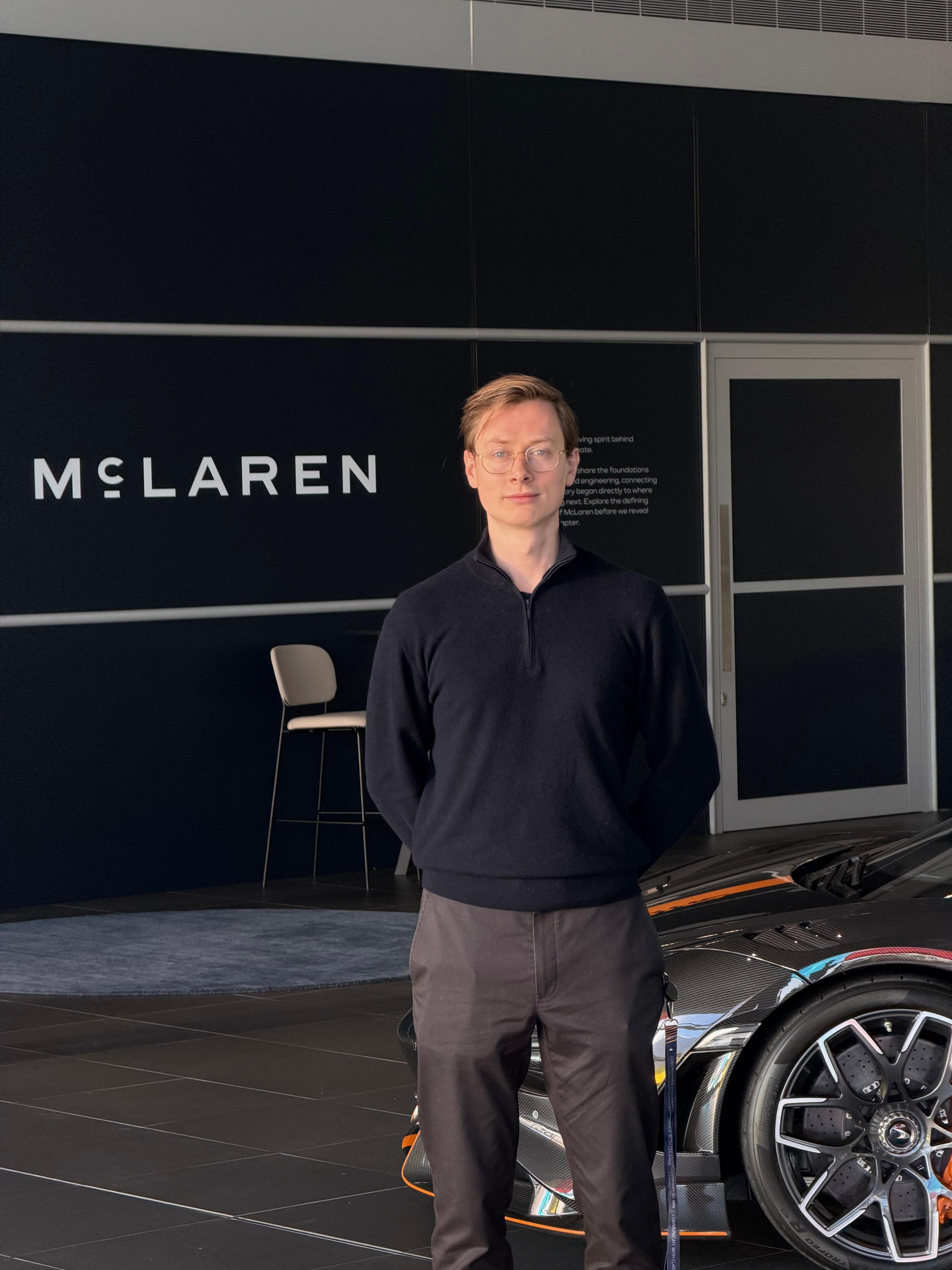
In your current role as a Design Engineer at McLaren Automotive, you work on advanced Body-in-White composite and metallic structures. What are some of the most exciting design or structural challenges in engineering next-generation supercars?

It always comes down to pursuing every gram, at the right cost and to the right quality. In Body-in-White, we work with composite and metallic structures, and every choice affects weight, crash performance, cost, and how the car feels/behaves. I’ve delivered systems for cars like the Artura and W1, amongst others, working closely with manufacturing, suppliers, and teams across the business. Balancing all of that and seeing products hit the road is what makes it so rewarding.
Alongside structural design, you lead AI-powered continuous improvement initiatives at McLaren. How do you see AI transforming supercar design, testing, and manufacturing over the coming years?
I’ve built various AI process tools at McLaren, so I’ve seen both the potential and the practical side. Being part of the wider AI transformation isn’t only about building tools. It’s about understanding what happens when you put AI into live workflows, managing context well, and educating colleagues so they can use it with confidence.

One interesting challenge right now is that AI has made it incredibly easy to build internal tools. Almost anyone can do it, and many people have great ideas, so tools start appearing everywhere.
That energy is brilliant, but the real work is channelling it: bringing the best ideas together, consolidating them into proper toolsets and processes, and building them on the right architecture, infrastructure, and cybersecurity. Otherwise, you end up with a patchwork rather than a platform.
Looking ahead, I see AI as a brilliant assistant, and with agentic capabilities developing fast, it can take on much of the repetitive work and admin. That frees engineers to focus on bigger decisions and creative problem-solving, which is where people add the most value.
You also founded Vanté Automotive, which ships premium aftermarket parts to six continents. What led you to start your own brand, and what has been the most rewarding part of running an automotive business?
Vanté started as an idea back in high school—initially as a portfolio to showcase what I could design and build. In 2024, I turned it into a real business, and it has since grown into a global brand shipping to almost every continent.
A product I’m particularly proud of is a modular rear wing developed for Audi Group vehicles. Engineered from aerospace-grade carbon fibre, it uses a distinctive fastening system with swappable elements so customers can tailor the setup to their individual cars. It was a demanding product to develop: it had to withstand serious aerodynamic downforce loads on a small initial production run, all while minimizing weight without compromising structural integrity.
The most rewarding part is seeing customer cars on the other side of the world fitted with our components, knowing something that began as a sketch on a screen has found a home thousands of miles away.

From motorsport to production cars and starting your own company, what is one of the toughest engineering or business lessons you’ve learned along the Way?
That a great idea is only the beginning, and that perfect is the enemy of shipped. I’m someone who loves the details, and in engineering that’s often a strength. But I’ve learned the hard way that spending too much time on tiny details can slow you down, especially in a business. Sometimes you need to be agile, get the product out there, and learn as you go. Customers and real-world feedback teach you things no amount of polishing in advance ever will.
The balance I try to strike now is to be rigorous where it truly matters, like safety, quality, and getting critical things right the first time. For everything else, I try to move quickly, ship, learn, and improve. I’ve also learned to ask for help sooner, and to treat setbacks as part of the process.
Out of all the vehicle platforms, parts, or technologies you’ve contributed to so far, what project are you most proud of?
The W1 stands out. I remember late nights in Spain at our proving ground, working on prototype cars, with a team all pulling in the same direction. Those moments, and seeing the car come together, are what I’m proudest of, and they’re when I felt this was what I’m meant to do. A close second is my own business, Vanté, because it’s something I built from an idea into a global brand.

What advice would you give current St. Stephen’s students or young alumni who dream of breaking into motorsport, supercar engineering, or founding their own company?
Go out there with the strong foundation St. Stephen’s gives you, and be open to everything. Try different things, even if you don’t know where they’ll lead. Follow your passion, work hard, and it can take you anywhere. I started with a school team and a portfolio idea, and it’s taken me to F1, McLaren, and my own business.
How has your connection to Rome and the St. Stephen’s community stayed with you throughout your international engineering journey?
Rome is where I grew up, and it comes with me everywhere. It gave me an international outlook, friendships that have lasted, and unlocked my internal drive. I still spend a lot of time with friends from school, which says a lot about the community. I’d love to help any current students or alumni who want advice on engineering, motorsport, or AI transformation!